Control Theory for Neural Systems
Aerospace controls PhD turned computational neuroscientist · seeking research scientist roles
I’m currently open to research scientist positions in computational neuroscience, neural engineering, and control of complex dynamical systems. Reach out at aditya.158@gmail.com or on LinkedIn.
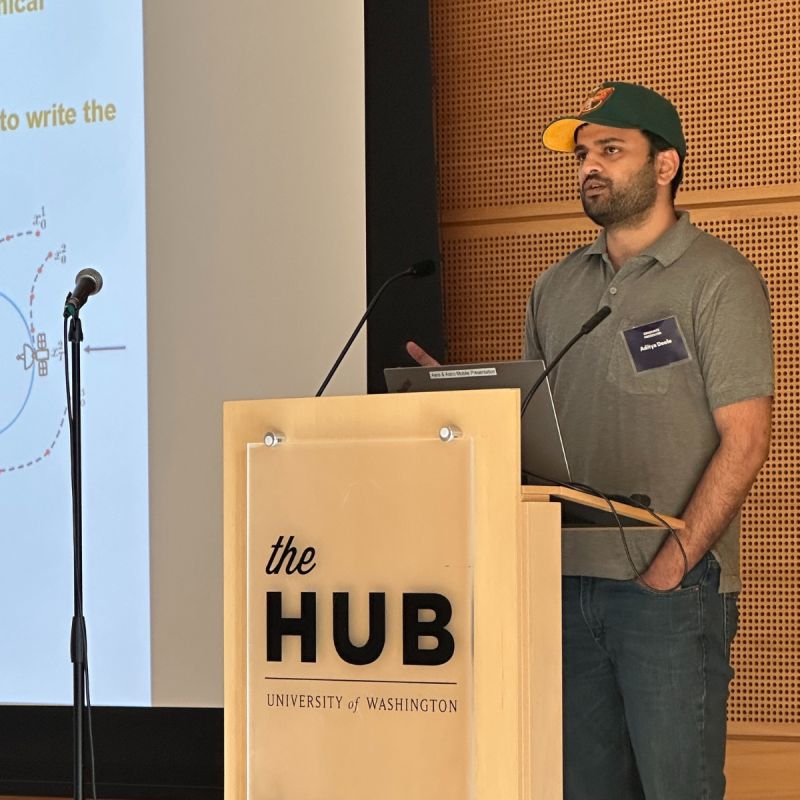
Hi, I’m Aditya. I’m a control theorist working on closed-loop control of neural systems. I design real-time feedback controllers and estimators that read population neural activity and steer it toward physiologically meaningful targets — across optogenetic and electrical stimulation, and across recording modalities from widefield imaging to µECoG.
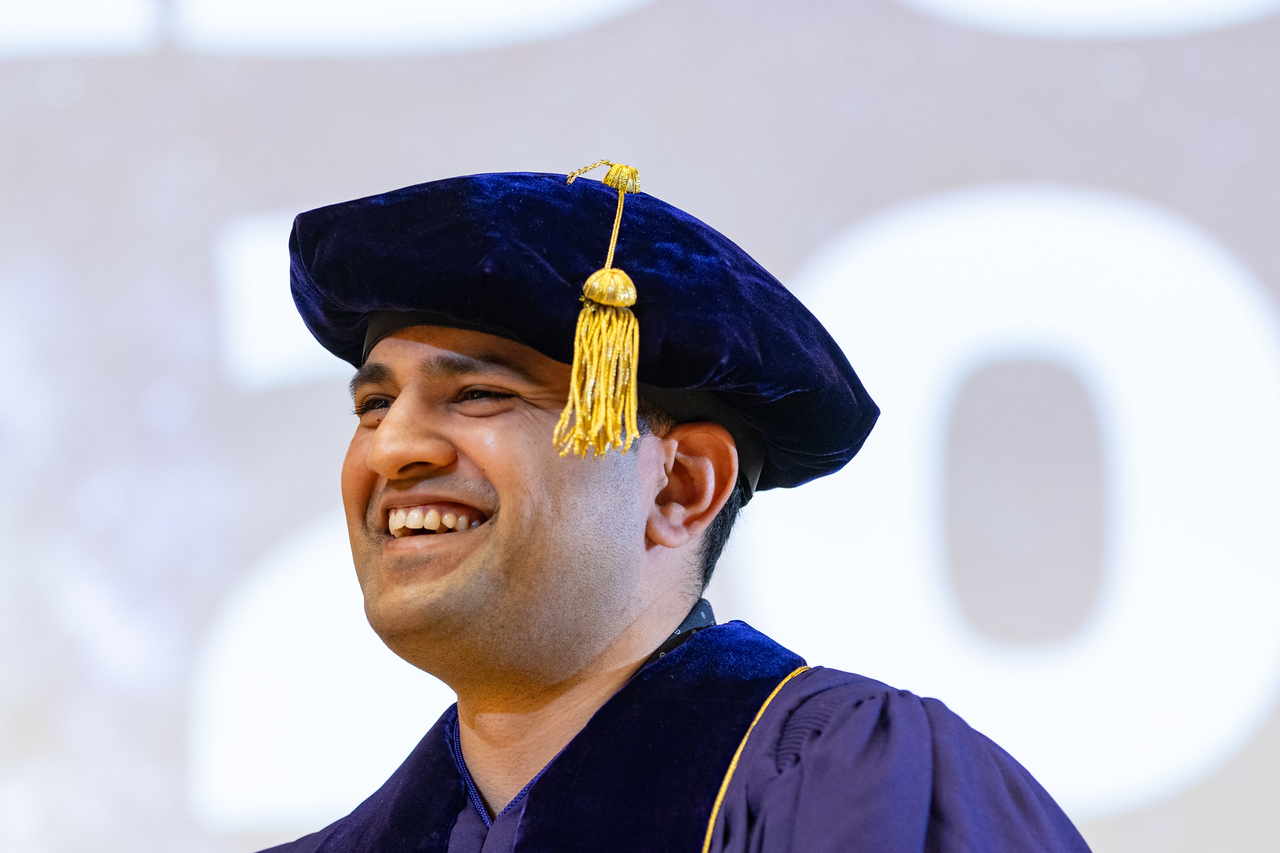
I received my PhD in Control Theory from the Dept. of Aeronautics & Astronautics at the University of Washington in June 2025, advised by Prof. Mesbahi, where I worked on robust control and estimation for spacecraft guided by machine-learned perception. The questions turn out to transfer directly: controllability, observability, and robust synthesis under uncertainty are the same tools whether the plant is a spacecraft with an unreliable sensor or a cortical population you can only partially observe and only partially drive. I now bring that foundation to the design of neural interfaces and stimulation therapies, as a postdoctoral researcher at UW’s Steinmetz Lab and NERD Lab.
My research interests include:
- Closed-loop control of neural population dynamics
- System identification for high-dimensional, partially-observed biological systems
- Controllability and reachability analysis for neural stimulation
- Estimation-aware planning and robust control under set-valued uncertainty
Selected Work
Closed-loop control of neural systems
Current work — Steinmetz Lab and NERD Lab, UW. Presented at NeuroAI 2026, Allen Institute, Seattle, with Anna Li, Eric Shea-Brown, Mehran Mesbahi and Nick Steinmetz. Slides (PDF)
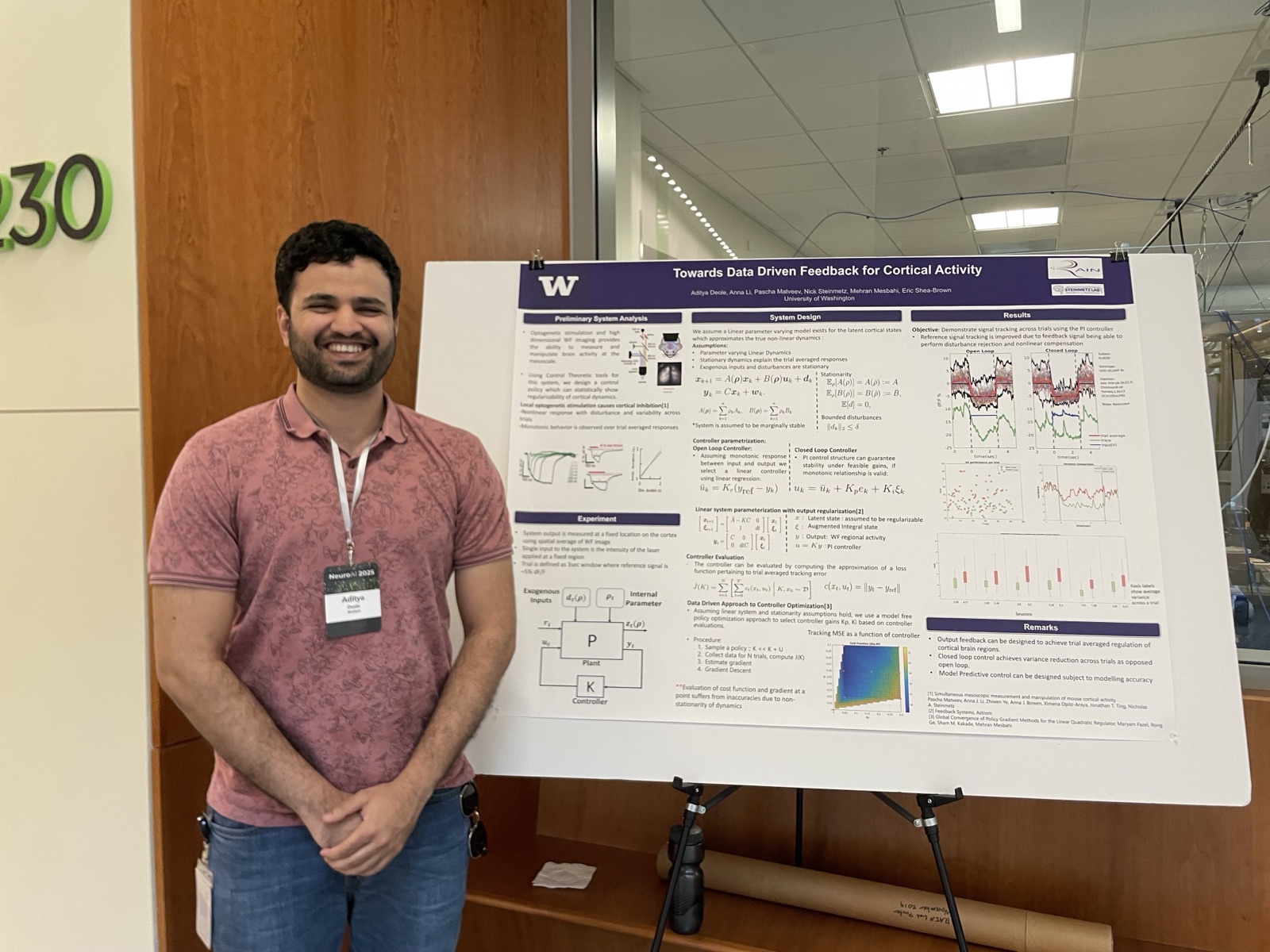
Mesoscale cortical activity carries signals relevant to behavior and perception, and it can be both measured — widefield imaging, cortex-wide — and driven, by targeted optogenetic stimulation. So the question the work is built around is whether it can be controlled, with the end goal of shaping behavior itself. Control theory is the right frame for that: it brings robustness, safety guarantees, and energy optimality, instead of stimulation protocols tuned by hand.
The difficulty is that cortex behaves like a noisy, parameter-varying system. Brain state shifts its resonant frequencies, movement drives global activity, and interactions between regions arrive as unmodelled disturbance, so the same stimulus gives a different answer trial to trial. What makes it tractable is that the trial-averaged response is approximately linear — a low-order LTI model explains it, cross-validated — which is enough to design against, provided the controller absorbs the variability the average hides. That is a PI output-feedback loop, running in real time, with gains chosen by optimizing over a cost map rather than by hand.
Given a model of the plant, the same loop can follow a moving reference rather than a fixed one. Feedback corrects the amplitude error, and previewing where the reference is heading recovers the phase that feedback alone loses to plant lag.
The controller doubles as a measurement instrument: a wrong internal model shows up immediately as tracking error, so closed-loop performance reads out properties of the system — movement improves controllability, while synchronization degrades it. Next are an explicit disturbance-rejection model, finding the subspaces that are most observable and controllable, and multimodal control across interacting regions — all steps toward closing the loop on behavior.
Estimation-aware planning under set-valued uncertainty
PhD work — RAIN Lab, UW Aeronautics & Astronautics.
Paper (JGCD 2025) · Code and videos
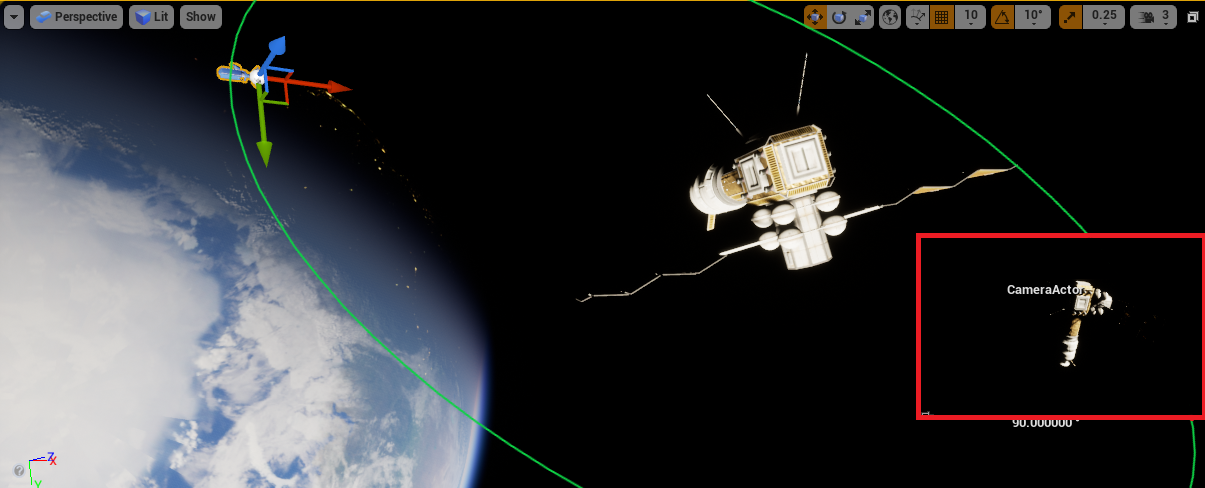
This is where the observability machinery I now apply to neural systems came from. A neural network deployed in a physical environment often behaves like a state-dependent sensor — a keypoint network’s uncertainty, for instance, depends on the illumination it happens to be in. If uncertainty depends on state, the trajectory itself becomes a design variable for estimation quality: you can plan a path that makes the system easier to estimate while still completing the task.
I model the ML uncertainty as bounded sets, define an observability condition on the resulting output tubes, and solve the optimal control problem with sequential convex programming.
With a network of agents the setup improves further, by quantifying the directions in which information is missing and solving the problem sequentially across agents.
Experimental systems and hardware
Alongside the theory, I build the systems the theory runs on: real-time, multi-threaded image- and signal-processing pipelines in Python for online neural feedback, and before that a simulation and robotics stack for testing controllers against real sensor behaviour.
I also built and supervised educational hardware testbeds for aerial and ground robots at the RAIN Lab, including a ROS2 ground-robot platform for testing trajectory optimization and an in-house indoor positioning system.
Selected Publications
- A. Deole, N. Steinmetz, et al. “Towards Data-driven Feedback for Cortical Activity.” NeuroAI, 2025.
- Z. Lu, A. Deole, et al. “Benchmarking Probabilistic Time Series Forecasting Models on Neural Activity.” NeurIPS 2025 Workshop.
- A. Deole, M. Mesbahi. “Estimation-Aware Trajectory Optimization with Set-Valued Measurement Uncertainties.” Journal of Guidance, Control, and Dynamics, 2025.
News
Talk at NeuroAI 2026, Allen Institute — August 2026
Presented Closed-loop control of mesoscale cortical activity at NeuroAI in Seattle, hosted at the Allen Institute. Slides (PDF)
Poster presentation at NeuroAI 2025
Defended my PhD thesis — June 2025

UW Graduate Showcase 2025